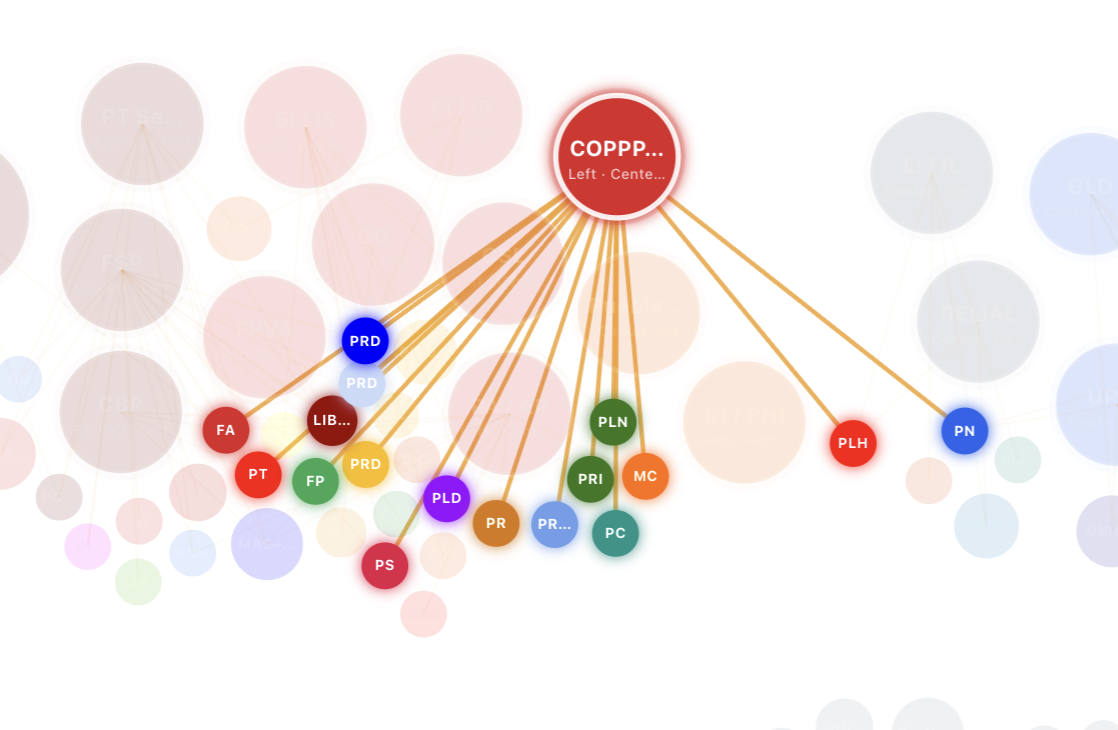
Parties are shaped by the countries they emerge from. Yet across borders, they often find peers who think like them, tied together by international party organizations: forums for coordination, information sharing and joint action.
Plural maps those ties because they make parties comparable across borders, and because they say a lot about who a party is and who it wants to be seen with.
International Party Affiliations: Why do they matter?
Identifying the ideology of a Latin American party is no easy task. National context shapes where each party falls, and many parties are built around leaders rather than programs. Here, a party's international ties can offer a useful hint about what kind of party we are looking at.
International party affiliations are formal memberships in transnational organizations, from global bodies like the Socialist International to regional forums like the São Paulo Forum. Taken together, they form a map of political kinship across the region: who stands with whom, and on what terms. This post explains what these networks are, what they do, how they came to be and why Plural tracks them.
Families, affiliations and organizations
Three terms tend to get used interchangeably, and it helps to keep them apart.
A party family is an analytical category. Scholars group parties by shared ideological origin: social democrats, Christian democrats, liberals, conservatives, Greens. The standard typologies were built for Western Europe, where parties grew out of historical conflicts between workers and owners, church and state, center and periphery, and other social cleavages. Latin America's party systems formed under different conditions, so those categories travel only partly.
An affiliation, by contrast, is an observable fact: a party's formal membership in a transnational body. It can be checked, which is why Plural codes it. The body itself is an international party organization. Some are global, like the Socialist International (SI / IS) or the Centrist Democrat International (IDC-CDI); others are regional, like the São Paulo Forum (FSP) or the Union of Latin American Parties (UPLA).
Party family is a label; affiliation is the party's choice. The two often align, and where they don't, the gap tells you something.
What these networks actually do
Membership is more than a logo on a party's website. Six functions recur across these networks.
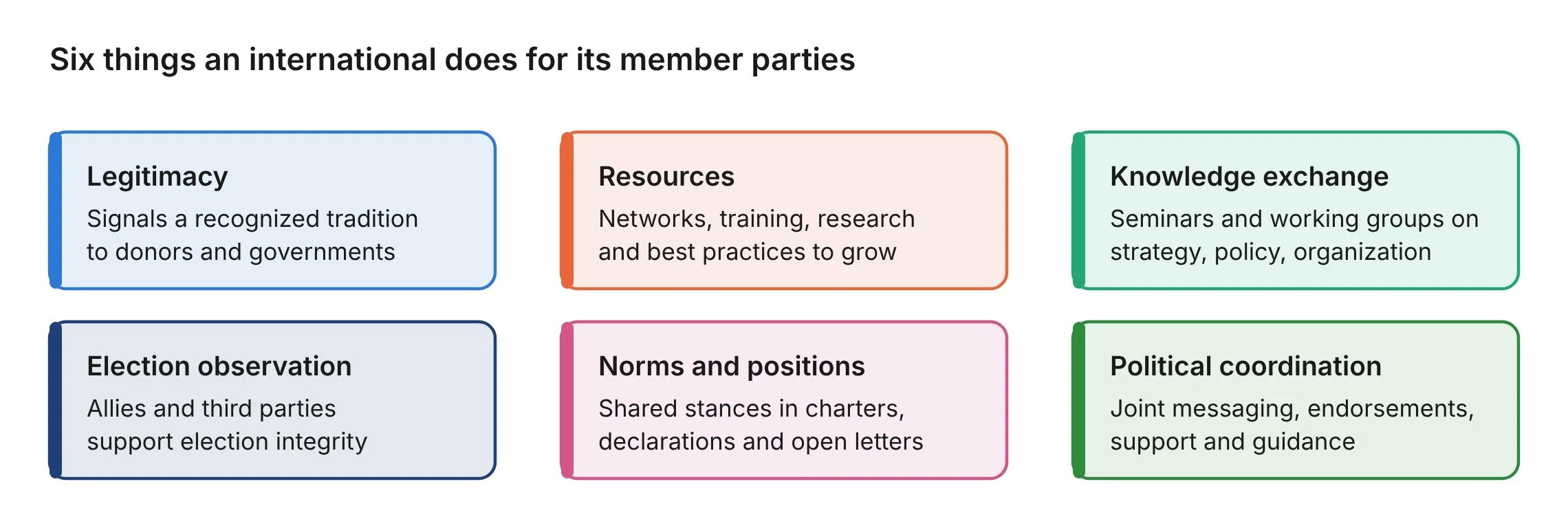
For a young party, joining an international can be a shortcut to infrastructure it would take decades to build alone: a recognized label, schools for its cadres, policy expertise and a circle of peers who have already governed. For established parties, the same networks are a platform to project their positions abroad, build alliances with like-minded governments and stand behind sister parties facing difficult elections. Either way, membership turns a national party into part of a regional conversation.
Three waves of networks
The region's affiliation landscape was not built in one go. It accumulated in layers, each a response to the politics of its time, and many parties still carry memberships from more than one.
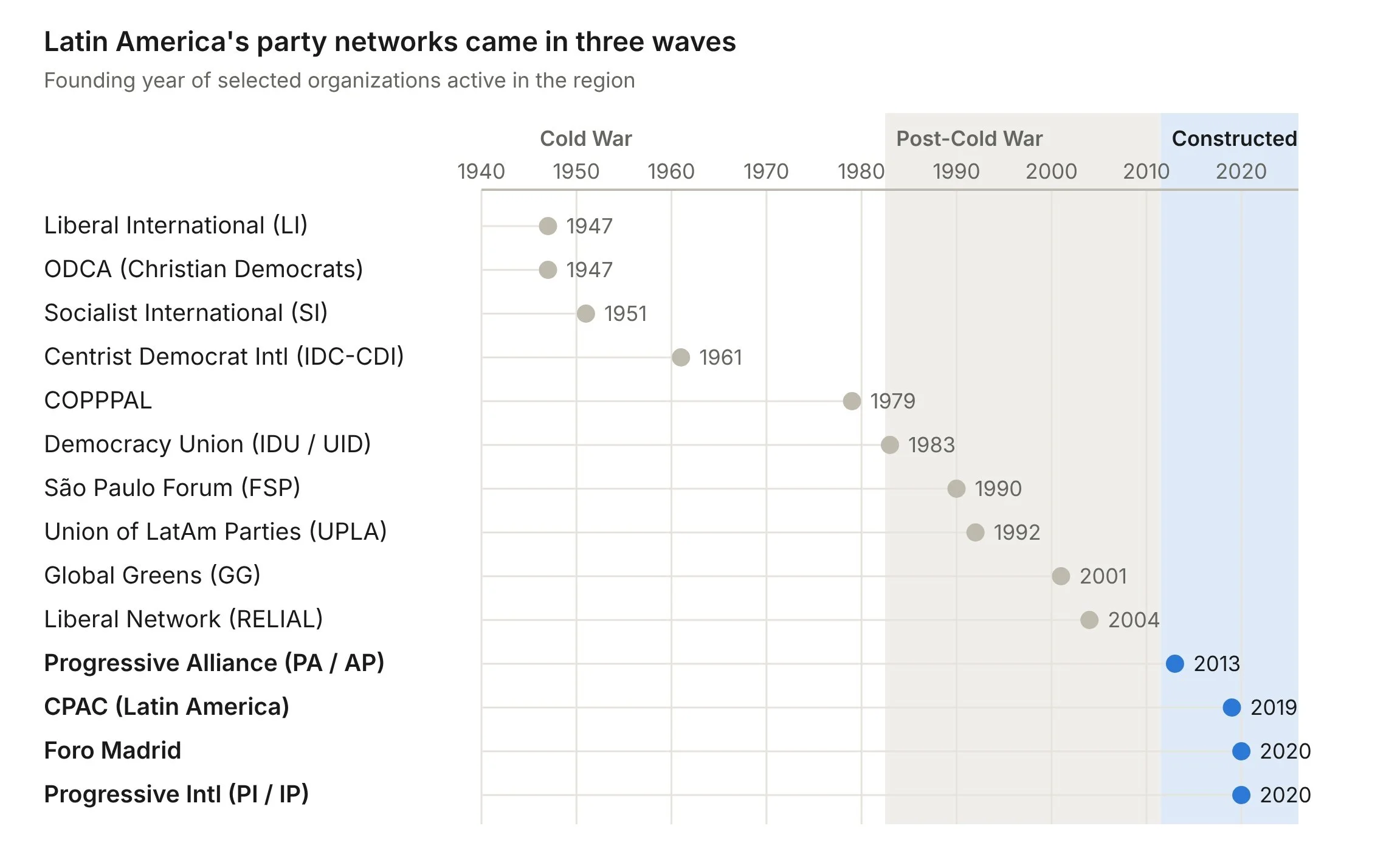
The Cold War wave (1940s–1980s). The first networks arrived as extensions of the European party families rebuilt after the Second World War. ODCA coordinated the region's emerging Christian democratic parties, the Liberal International brought in its historic liberal parties, and the Socialist International gathered social democratic and left-wing forces. In 1979, Mexico's PRI launched COPPPAL, a big-tent forum for the region's pro-sovereignty parties and a coordinated regional response to an increasingly bipolar world.
The post-Cold War wave (1980s–2010s). As the Cold War wound down, space opened for networks built in and for the region. On the right, the International Democracy Union, founded in 1983 by Margaret Thatcher, Helmut Kohl and other conservative leaders, gained a Latin American arm in UPLA, which consolidated the region's conservative parties. On the left, Brazil's Workers' Party and the Communist Party of Cuba founded the São Paulo Forum in 1990, bringing together many of the parties that would govern during the "pink tide" of the 2000s. Liberal parties and think tanks organized through RELIAL, and Green parties formed their own global network in 2001.
The constructed wave (2010s onward). The newest networks look different. On the left, social democrats frustrated with the Socialist International founded the Progressive Alliance in 2013, and the Progressive International followed in 2020 as a more activist alternative. On the right, Foro Madrid, launched in 2020 by the foundation of Spain's Vox, frames its mission as resisting "21st-century socialism" across the Spanish-speaking world, while CPAC has brought its conservative gatherings to Latin America. Many of these networks are less about formal party membership than about coordination: they gather leaders, legislators, think tanks and activists around shared messaging and a shared adversary. They reflect a more polarized region, where alliances are built deliberately rather than inherited.
A useful but noisy signal
Affiliations are powerful, but they need reading with care. Membership is a choice, and parties make it for many reasons besides ideological kinship.
The first is strategy. During the Cold War, internationals recruited parties for their geopolitical weight as much as their programs, and parties joined for resources and international standing. The Socialist International's Latin American roster of the late 1970s and early 1980s spanned Colombia's Liberals, Nicaragua's Sandinistas, Panama's PRD and Peru's APRA: very different projects under a single social democratic banner. Memberships formed in that era often outlived the reasons for them.
The second is translation. European party families grew out of European conflicts, and they map imperfectly onto Latin America. Across much of the region, economic and cultural positions move together: a party that is economically left is almost always socially progressive too, which leaves little room for some of Europe's familiar combinations. The far right is a good example. In Europe it is defined largely by hostility to immigration; in Latin America, religious conservatism plays that role. Even a single family can cover very different projects, as Christian democracy in Chile, Mexico and Venezuela shows.
The third is where the boundaries fall. Networks are drawn by politics as well as programs. On the left, the clearest divide between the Progressive Alliance and the Progressive International is not economic policy but attitudes towards the governments of Venezuela, Nicaragua and Cuba, which the first excludes and the second does not. Labels can also mislead in both directions: some parties widely regarded as right-wing sit in left-leaning organizations, and vice versa. And parties that have drifted from their programmatic roots often keep their memberships long after the ideology has gone.
Finally, affiliation favors the stable. In volatile party systems, many parties do not last long enough to join anything. Membership records are uneven too, and some networks fall dormant without ever formally closing. None of this makes affiliations less useful. It means reading them for what they are: evidence of where a party is embedded and whom it chooses to stand beside, rather than a shortcut to its ideology
Why we track them anyway
Read with care, affiliations do something few other indicators can: they let you compare parties across borders on common terms. Membership is recorded the same way in every country, so a reader can line up a Mexican party next to a Costa Rican one and ask what they share, without first settling every argument about ideology.
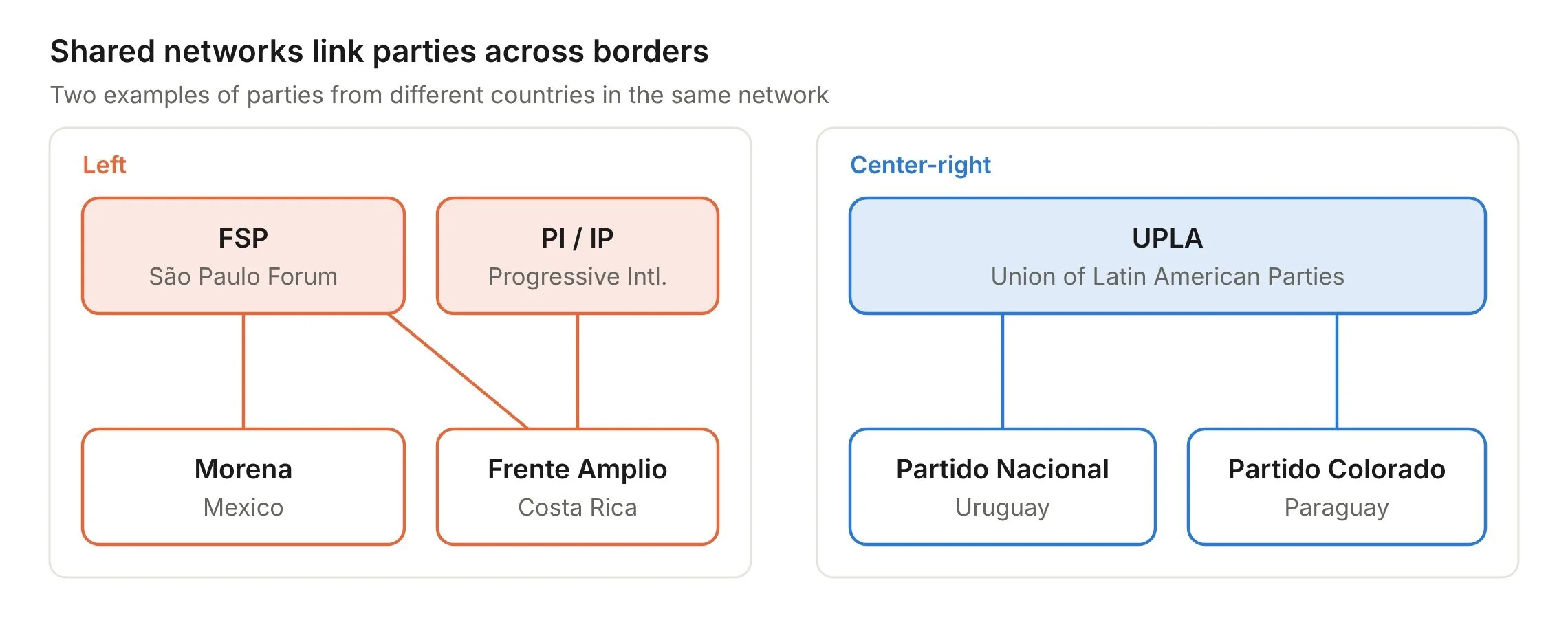
Take Mexico's Morena and Costa Rica's Frente Amplio. One is a governing giant founded in 2014; the other a smaller party of the Costa Rican left, a decade older. Both belong to the São Paulo Forum, and Frente Amplio is also part of the Progressive International. On the other side of the spectrum, Uruguay's Partido Nacional and Paraguay's Partido Colorado, two of the oldest parties in the hemisphere, both sit in UPLA, yet they compete in very different democracies. Shared membership is where comparison starts: what do these parties have in common, and what explains how differently they behave at home?
Affiliations also give a quick flavor of who a party is. Joining Foro Madrid or the Progressive Alliance is a public statement about which company a party wants to keep, and choosing not to join anything is a statement too. And because membership shapes who trains a party's cadres, who observes its elections and which foreign governments treat it as a counterpart, it is a guide to a party's reach beyond its borders.
That is why affiliations sit in every party profile in Plural's database: one layer of a fuller picture, and often the quickest way into it.
How to read Plural's affiliation network
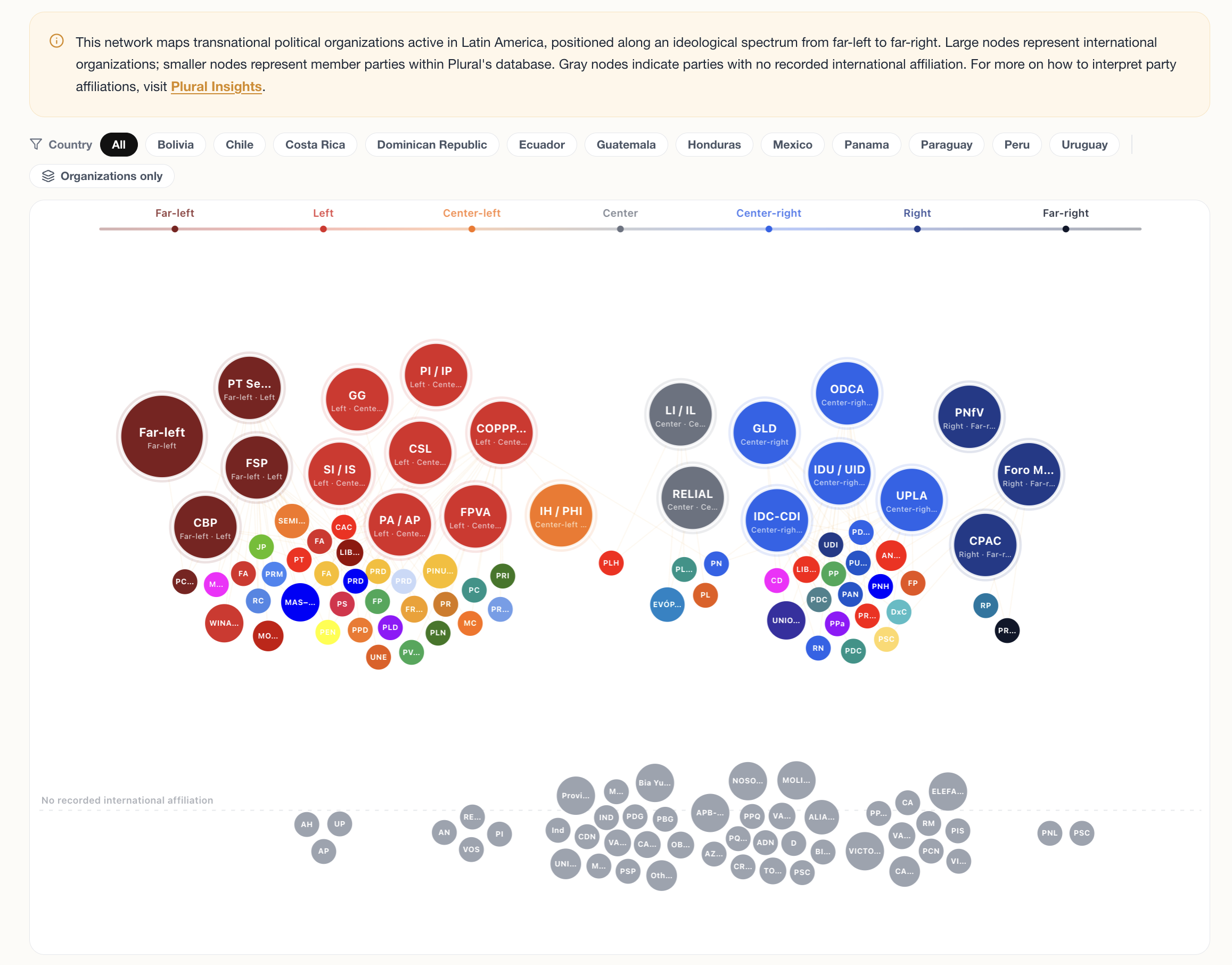
The affiliation network on Plural's dashboard places every organization on a spectrum from far-left to far-right. The large nodes are the international organizations; the smaller ones are the parties in our database, each linked to the networks it belongs to. Parties with no recorded affiliation sit in gray along the bottom. You can filter by country to see one party system's international ties, or switch to organizations only to see the landscape of networks on its own.
A few patterns stand out at a glance. The left is crowded with overlapping networks, a legacy of each wave adding new forums without retiring the old ones. The right is organized around a few established hubs, with a newer, more assertive fringe at its edge. The center is thin. And the gray row is long, which is itself a finding about how many of the region's parties operate without any international anchor.
Further reading
Borges, A. & Zanotti, L. (2025). Authoritarian, but not nativist: classifying far-right parties in Latin America. Comparative Political Studies.
Garategaray, M. (2024). Transnational social democracy: the Socialist International and the Friedrich Ebert Foundation in Latin America. Journal of the History of Ideas Blog.
Gomáriz Moraga, E. (2022). The progressive internationals in Latin America. Latinoamérica21.
Hällhag, R. (2008). Political party internationals as guardians of democracy. Internationale Politik und Gesellschaft.
Loxton, J. (2021). Conservative Party-Building in Latin America: Authoritarian Inheritance and Counterrevolutionary Struggle. Oxford University Press.
Mainwaring, S. (ed.) (2018). Party Systems in Latin America: Institutionalization, Decay, and Collapse. Cambridge University Press.
Mair, P. & Mudde, C. (1998). The party family and its study. Annual Review of Political Science.
Martínez-Gallardo, C. et al. (2022). Revisiting party system structuration in Latin America and Europe. Party Politics.
Palestini, S. & Rovira Kaltwasser, C. (2025). Foro Madrid and the transnationalization of the far-right. In Global Challenges to Democracy, Cambridge University Press.
Pedrosa, F. (2015). The Socialist International's Committee for Latin America and the Caribbean, 1976–1983. Izquierdas.