Policy Paper - Welcome to the Party: Fixing the Institutions that Make Democracy Work
Welcome to the Party: Fixing the Institutions that Make Democracy Work
Across Latin America, political parties are in crisis. Widely viewed as corrupt, self-serving and fleeting, they now rank among the region’s least trusted institutions. This is not just a political problem; it is a democratic one.
Let’s fix them.
Summary
Since the third wave of democratization, most Latin American countries have held regular, competitive elections. Yet over the past two decades, support for democracy and trust in political institutions have declined across much of the region. Electoral competition is increasingly dominated by parties that lack organizational continuity, ideological coherence or durable roots in society.
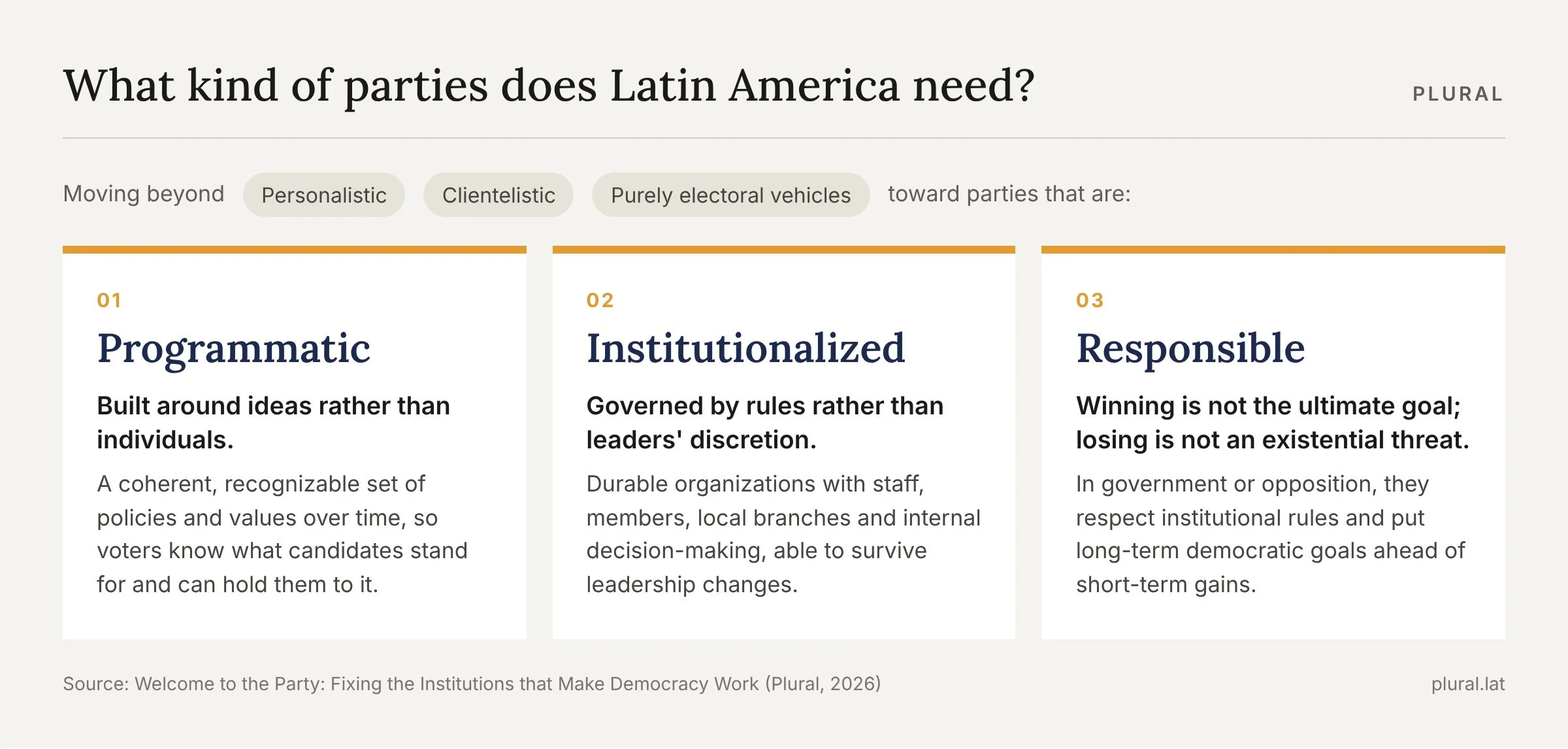
But the problem is not parties themselves; it is the kinds of parties that exist. This paper examines the essential functions parties perform in democracies, diagnoses the dynamics driving their decline across Latin America, and outlines what building more responsible political parties requires.
Key arguments
No democracy can function without parties. Parties structure electoral competition, link citizens to the state, organize governance, recruit leaders and enable accountability. When they cannot perform these functions, democracies falter.
Latin America faces a crisis of party types, not of parties. Personalism, clientelism and the proliferation of single-cycle electoral vehicles have crowded out programmatic organizations. Only 17 percent of Latin Americans trust political parties.
Party collapse opens the door to backsliding. In Venezuela and El Salvador, the failure of established parties did not simply produce a change of leadership; it created the conditions for democratic erosion.
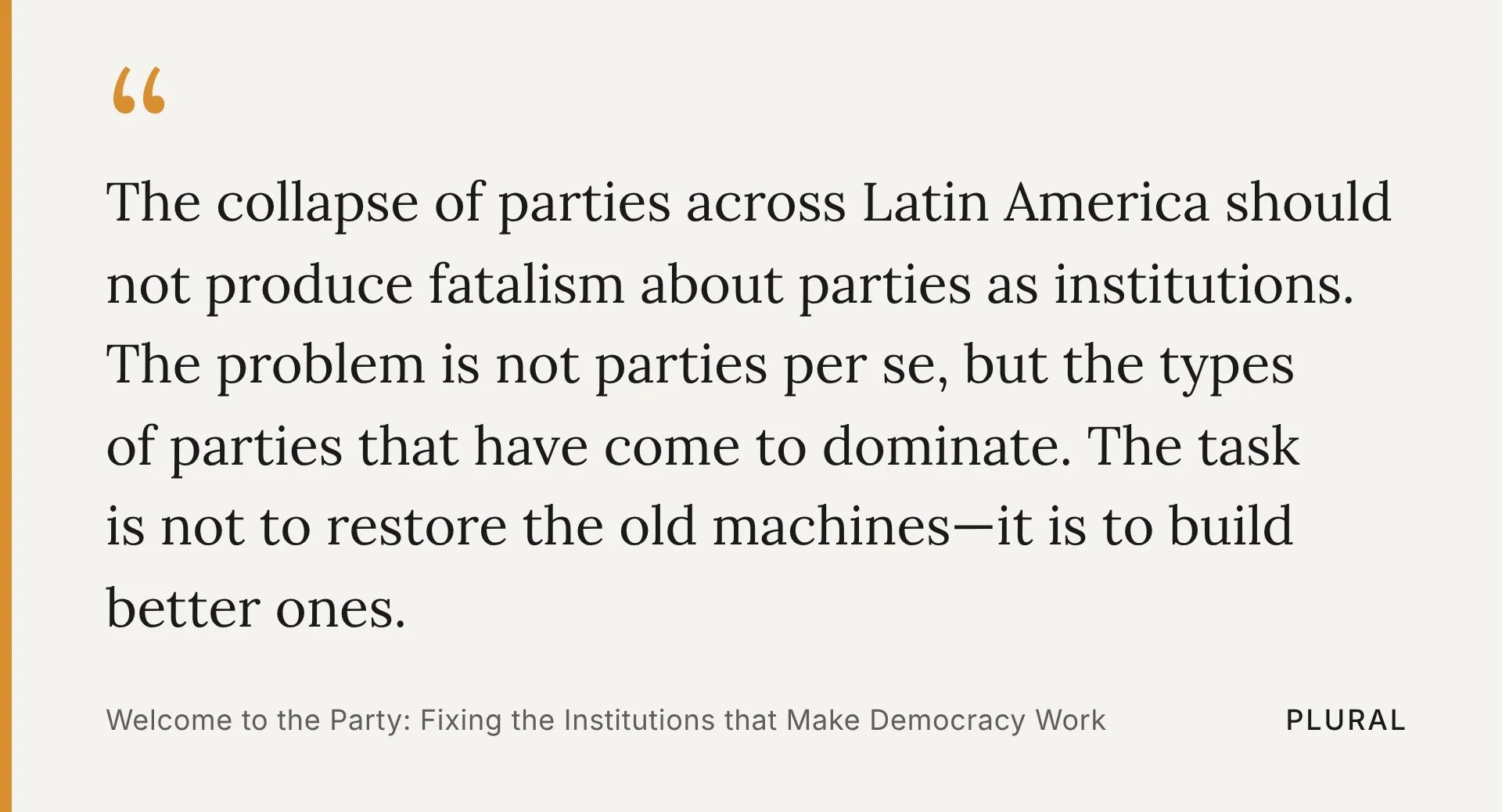
The task is not to restore the old machines, but to build better ones. The region needs parties that are programmatic, institutionalized and responsible, and comparative evidence shows they can be built even under adverse conditions.
The research gap is at the party level. Most work studies party systems in aggregate. How parties select leaders, train candidates, resolve conflict and survive between elections remains underexplored.
Explore the data
See party-level profiles across Latin America on the Plural Party Dashboard.
Part of the series
This paper launches Welcome to the Party, Plural’s first initiative, alongside country reports on Peru, Mexico, Colombia and Brazil. All publications.
Cite this paper
Arevalo Poincot, Henrique, Ipeksu Yucel, and Juliet Rotondo. 2026. Welcome to the Party: Fixing the Institutions that Make Democracy Work. Plural Policy Paper. October. plural.lat.