Country Report – Fuerza Popular in Power: A New Phase for Peruvian Politics?
Summary
Between 2016 and 2026, Peru cycled through nine presidents in ten years. Congress used censures, investigations and the threat of removal to dismantle the executive’s capacity to govern. Analysts came to describe the result as a de facto parliamentary autocracy. Fuerza Popular (FP) was the principal engine of that obstruction.
The 2026 election changed the structural conditions. FP now leads the executive and the largest bloc in Congress. The reinstated Senate adds a bicameral brake. A higher representation threshold cut the number of parties in Congress from ten to six. This report examines how Peru’s party system arrived here, what has changed, and whether the deeper dysfunctions of the last decade remain intact.
Peru’s party system at a glance
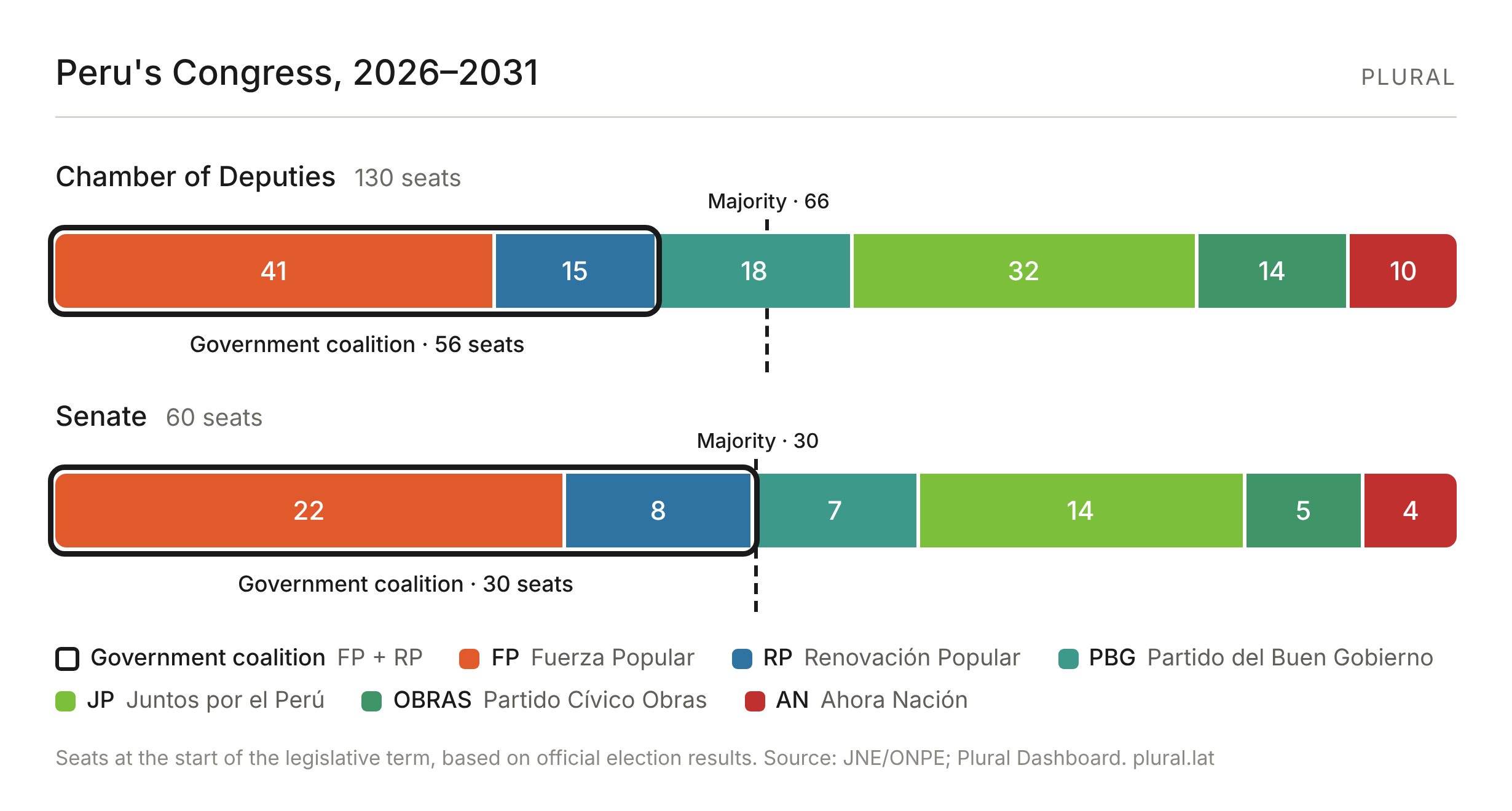
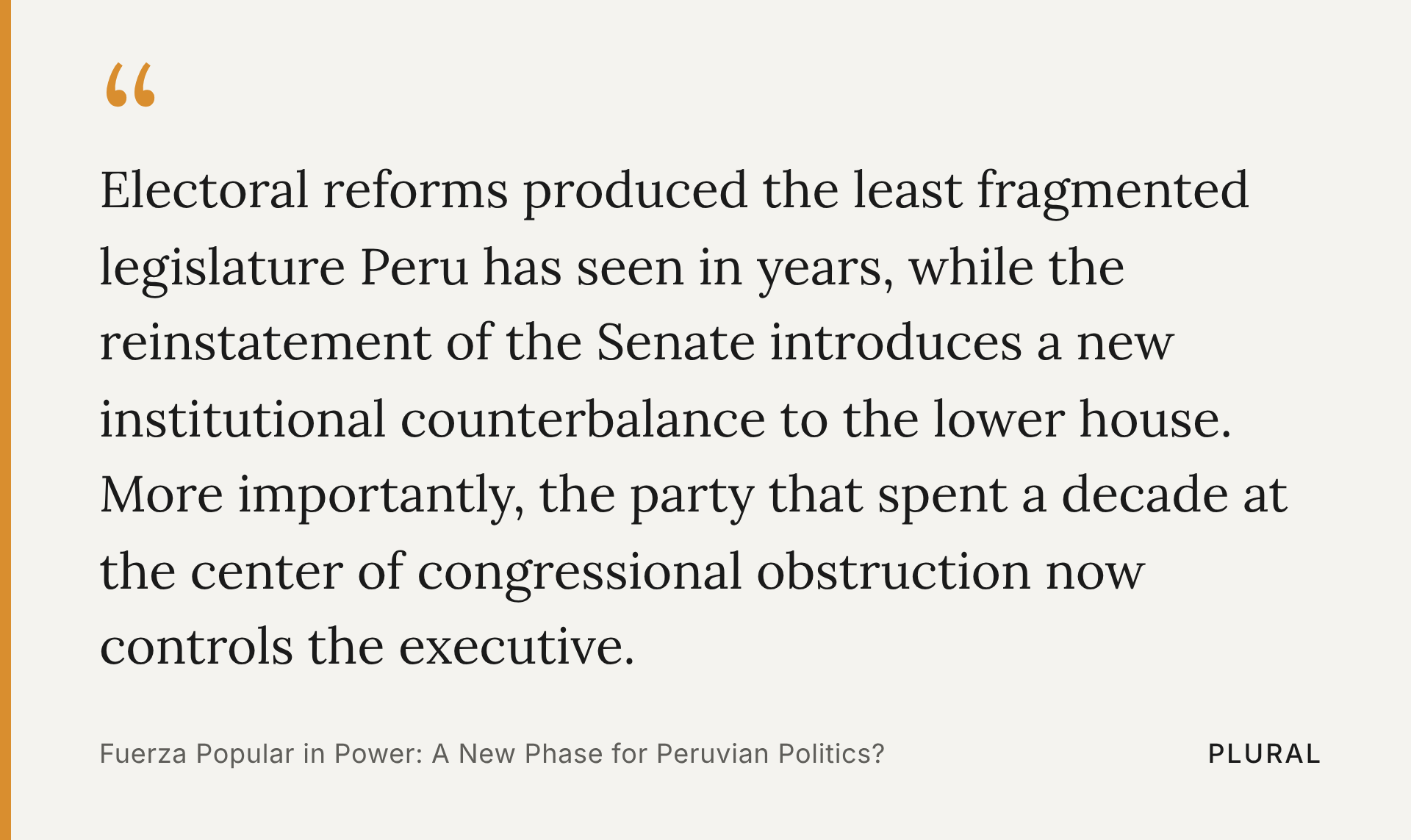
Peru is a presidential system with a bicameral Congress, restored in 2026 with the return of the Senate (60 seats) alongside the Chamber of Deputies (130). After a decade of extreme fragmentation, a higher representation threshold cut the number of parties in Congress from ten to six, the least fragmented legislature in years.
Key findings
Power has shifted back toward the executive. For the first time since 2016, the president’s party controls the Senate and leads the Chamber of Deputies, making systematic obstruction harder to organize.
Fewer parties do not yet mean stronger parties. All six parties in Congress were shaped by the 2026 presidential race. Their presence reflects electoral circumstance as much as organizational strength.
The opposition has no clear anchor. The left-wing bloc shares an orientation but not a project. Partido del Buen Gobierno (PBG) has emerged as the effective kingmaker.
National strength has not translated into territorial roots. In the October 2026 regional and municipal elections, FP won no governorship in the first round. Extra-parliamentary parties dominated subnational office.
Fuerza Popular in Power: A New Phase for Peruvian Politics?
After a decade of congressional obstruction, the party that led it now holds the presidency. This report asks whether Peru has entered a new phase or simply rotated its actors.
This report is part of Welcome to the Party, Plural’s first initiative, alongside country reports on Mexico, Colombia and Brazil. October 2026.
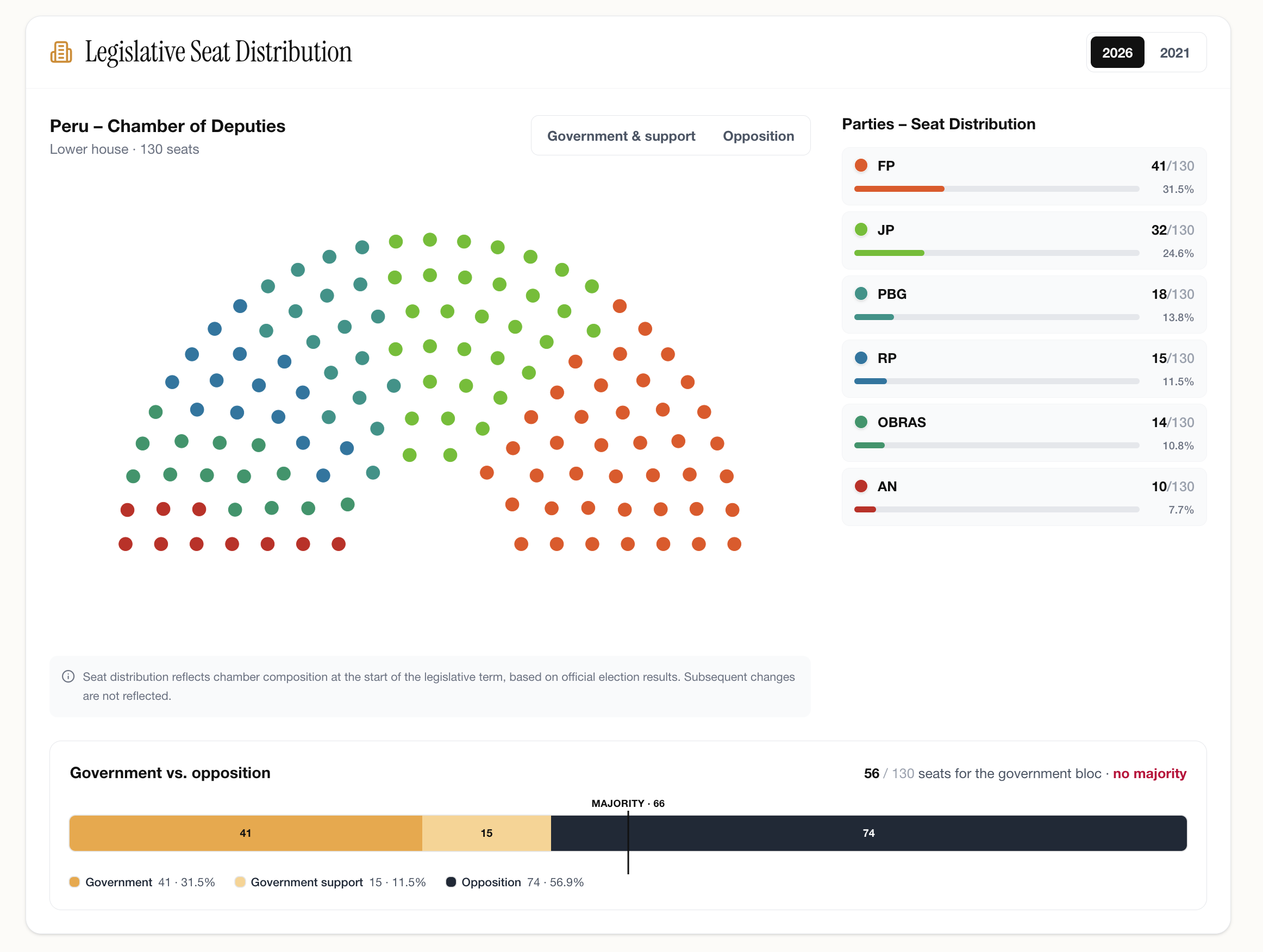
Explore the data on the Plural Dashboard.
Government coalition. Fuerza Popular (FP), the political vehicle of fujimorismo, is the largest party in both chambers. With Renovación Popular (RP), it controls the Senate but falls short of a majority in the lower chamber
Opposition. Juntos por el Perú (JP), heir to Pedro Castillo’s movement, leads the left-wing bloc alongside Partido Cívico Obras (OBRAS) and Ahora Nación (AN). The three share an orientation but not a common project.
Kingmaker. Partido del Buen Gobierno (PBG), a new centrist party led by Jorge Nieto, holds the balance in the Chamber. It has pledged oversight rather than obstruction.
What to watch
Whether FP can manage its coalition with RP through a full term. Its request for decree powers was granted only after Congress cut it to well under half of what the government asked for.
Whether the six congressional parties hold their blocs together, or whether defections and splits rebuild the fragmentation of the last Congress.
Whether the government can bridge, or will deepen, the rural–urban divide behind a decade of instability.
Whether government and opposition can rebuild trust in a Congress that only 5 percent of Peruvians trust.
Part of the series
This report is part of Welcome to the Party, Plural’s first initiative, alongside country reports on Mexico, Colombia and Brazil and the policy paper Welcome to the Party: Fixing the Institutions that Make Democracy Work. All publications
Cite this report
Arevalo Poincot, Henrique, Jackson Barber, and Matias Botello. 2026. Fuerza Popular in Power: A New Phase for Peruvian Politics? Plural Country Report. October. plural.lat.