Honduras’ 2025 Elections Report
Honduras’ 2025 Elections:
A Return to Bipolar Politics?
It's a bit more complicated than that.
After a fiercely contested election marked by recounts, annulment attempts, and fraud accusations from across the political spectrum, Honduras has sworn in a new president and legislature.
What does the balance of power look like now?
Nasry Asfura, candidate of the Partido Nacional de Honduras (PNH), was inaugurated as president after narrowly defeating the Partido Liberal de Honduras (PLH) and the incumbent LIBRE party.
At first glance, the result suggests a return to Honduras’ traditional bipartisan competition, with PNH and PLH remaining the dominant forces. But the details point to a more complex reality.
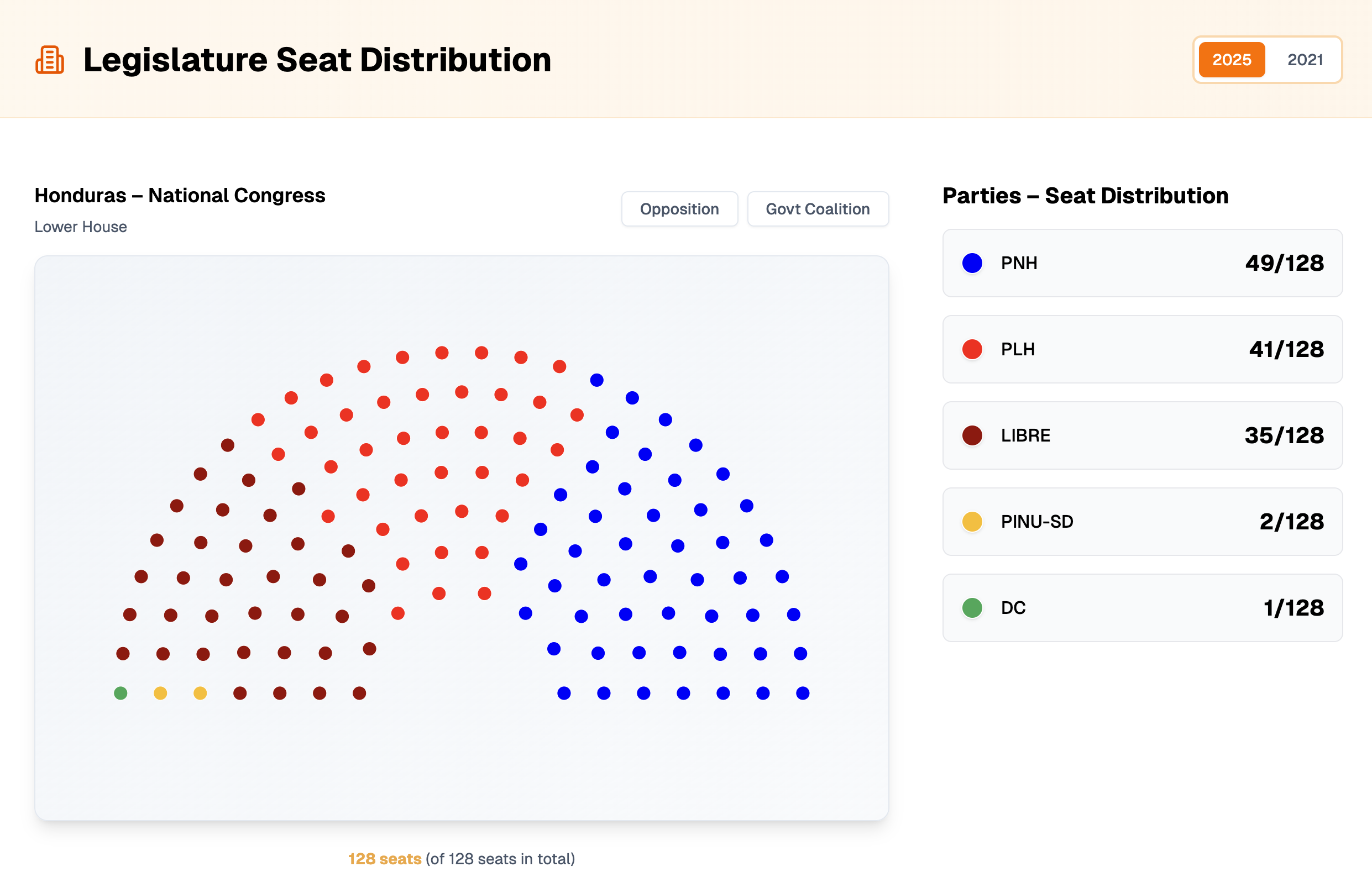
Explore Honduras’ new party configuration—who’s up, who’s down, and who’s who—on Plural’s Party Dashboard
From Breakthrough to Setback: LIBRE’s Weakness
LIBRE’s 2021 victory under Xiomara Castro disrupted decades of two-party dominance. Just four years later, the party placed a distant third.
This result does not erase LIBRE as a political force, but it does underscore its organizational weakness and limited consolidation beyond a single electoral moment. The party struggled to translate incumbency into durable electoral support, highlighting the challenges newer movements face when competing against long-established parties like PNH and PLH.
The Liberals: Nasralla’s Moment or a Comeback?
PLH’s strong performance was driven by Salvador Nasralla, who finished less than one percentage point behind Asfura and returned the Liberals to national competitiveness after their 2021 collapse. Nasralla was able to combine his outsider appeal, running a critical campaign against LIBRE and PNH and corruption, together with the enduring organizational advantages of one of Honduras’ two historic parties.
Nasralla’s trajectory is emblematic of Honduras’ fluid party landscape. He previously founded the Partido Anticorrupción (PAC) and later the Partido Salvador de Honduras (PSH)—both of which have since lost congressional representation.
Since the election, he has already broken with PLH’s leadership and opposed cooperation with PNH in Congress, raising questions about whether this result reflects a durable Liberal revival or another candidate-centered moment.
Governing Without a Majority
Despite winning the presidency, President Asfura’s PNH controls just over a third of Congress, making legislative politics central to governance.
Early signals of how Asfura will govern came with the election of congressional leadership:
A coalition of PNH and PLH, backed by minority parties PINU-SD and DC, reached a two-thirds majority.
PLH secured key leadership posts
LIBRE opposed the agreement
Nasralla and seven PLH deputies broke ranks and voted against it
The process has drawn criticism after Congress expanded the number of leadership positions and approved salary increases, moves widely interpreted as efforts to consolidate support through material incentives rather than programmatic agreement.
What This Tells Us.
Honduras’ 2025 elections point to a familiar pattern:
Traditional parties (PNH and PLH) remain electorally dominant
Newer movements struggle to consolidate power
Governability hinges on transactional bargaining, not stable or programmatic coalitions.
Whether or not PLH remains a united block in Congress will define Asfura’s ability to pass legislation.
The system delivers continuity. But with trust in political parties at 11% and in Congress at 16% (Latinobarómetro, 2024), it comes at the cost of deep public skepticism toward democratic institutions.